


Introduction
VOYCE – Whakarongo Mai, which stands for Voice of the Young and Care Experienced – Listen to me, exists to advocate for and amplify the voices of the 4,400 care-experienced children (those who have been or are currently in foster or residential care) in Aotearoa New Zealand.
VOYCE works to effect change in the wider care system by keeping children’s voices at the centre of all decisions made about and systems designed for them.
Established in 2017, VOYCE has grown to have 11 offices throughout New Zealand. The organisation’s model and ways of working have been co-designed in partnership with the young people it supports.
Continue reading to learn more about this project. Alternatively this case study is available to download as a PDF in English and Spanish.
The Model
VOYCE centres its work around the belief that care-experienced young people are already experts on the care system in New Zealand – they just need to be offered appropriate training and support to get their voices heard. With this in mind the VOYCE National Youth Council was established to ensure opinions of care experienced rangatahi (young people) were included in decision making, both internally within the organisation, and externally, impacting national policies which affect their lives.
In 2020, youth council members identified the need for greater regional representation and issued a wero (challenge) to the organisational leadership to develop youth councils across the country. Their ambition was to create opportunities for young people to be involved in collective advocacy and grow as young leaders and to create a greater impact through regional and national initiatives.
Regional Youth Councils have since been established in four regions across New Zealand. Each council comprises between five and 10 care experienced rangatahi aged between 16 and 25.
When joining a Regional Youth Council the young people commit to a two-year tenure. During this time they will attend hui (meetings) one weekend a month. The first couple of meetings are spent getting to know one another, learning about each other’s backgrounds and building relationships of trust. They will then move on to discussing their aspirations for the council and setting their own agenda of issues to focus on during their two years. During this time VOYCE provides continual leadership advancement to its members.
The young people who sit on the regional councils have usually first come into contact with VOYCE through one-to-one sessions with kaiwhakamana (youth workers/advocates); or have attended a regional t¯uhono (events run by VOYCE), such as bowling, a pool party, or a trip to a local beauty spot. Opportunities to sit on youth councils are promoted through monthly newsletters and social media posts. Regional Youth Councils usually meet once a month to discuss their concerns and priorities with their local regional teams.
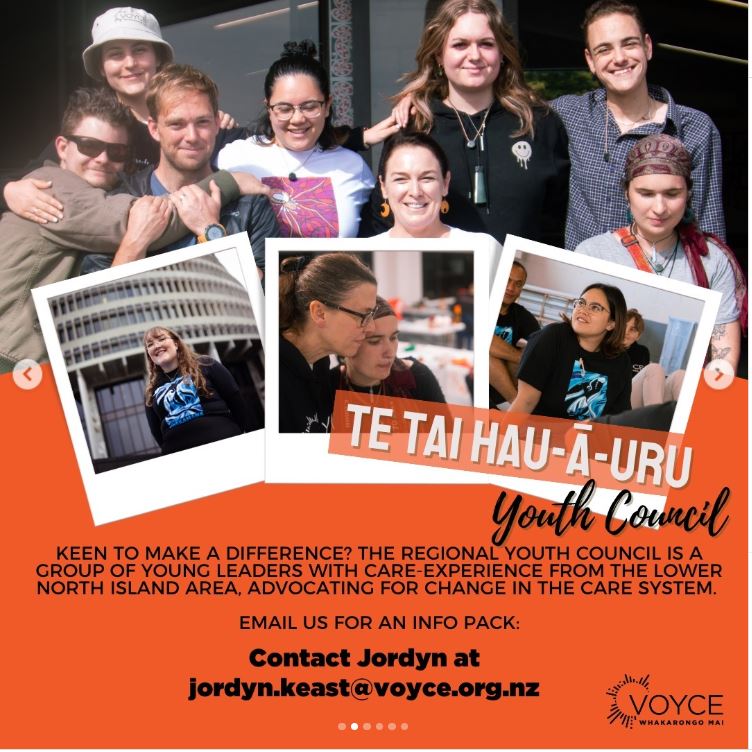
Above: A social media post promoting membership of the youth council.
VOYCE provides training and support to help transform the young people’s knowledge and passion into successful advocacy, and they can explore leadership opportunities along the way. To date the councils have worked on a submission for the United Nations Convention on the Rights of the Child, met with Parliament and policy advisors, presented at conferences at home and abroad, and much more. When young people give presentations to decision makers or speak to those in positions of power they are supported by VOYCE youth workers or advocates.
Since its foundation in 2017 VOYCE has sought to establish itself as the voice of the care experienced in New Zealand and to support this group’s representation at every level of decision making. While it has taken time to gain recognition, it is now considered the go-to organisation for institutions operating in this space.
In creating the Regional Youth Councils there has been some disparity between the regions, with networks being more established in some areas. VOYCE continues to work towards the goal of creating Regional Youth Councils nationwide.
Outcomes
Regional Youth Councils create t¯uhono (connection) between care-experienced young people. The rangatahi VOYCE works with had spoken about the isolation they often experienced in the care system and viewed creating their own community as a priority in their lives.
The Te Waipounamu (South Island) Regional Youth Council has worked with the government’s Mental Health and Wellbeing Commission review, providing input on how the government can increase its engagement with young people and include them in the decision-making process.
Through the councils VOYCE is creating a future generation of leaders with lived experience, furnishing the rangatahi with the skills needed to create the change they want to see. To date VOYCE council members have travelled to the USA and spent a day shadowing a member of Congress, earned a scholarship at the University of Oxford and gone on to sit in New Zealand’s Youth Parliament.
National and Regional Youth Council Members have spoken to Oranga Tamariki (Ministry for Children) staff around policy proposals and have fed back to the Royal Commission into Abuse in Care.
The National Youth Council developed a curriculum for training staff in the care sector titled ‘What I wish I knew: Promoting transparency between social workers and tamariki atawhai (adopted or fostered children).’ Members of the national and regional councils have also fed into Oranga Tamariki policy on staff training.
One member of the National Youth Council has gone on to become a full-time member of staff.
Resources Required:
- The willingness of those with lived experience to share their time and expertise. The young people who volunteer to share their insights should be supported and nurtured by the professionals they work alongside. This means due diligence should take place so the young people are not put in spaces where they do not feel comfortable or respected.
- Staff with an open mind who are willing to listen to and be guided by the young people they work alongside.
- VOYCE uses a CRM system to record which topics young people have identified as being important to them. Research specialists are able to analyse this data to determine which topics should be prioritised.
- Positive relationships with funders can create long term commitments which can lead to effective long-term planning. VOYCE welcomes government funding but admits it can be a double-edged sword as it can lead to concerns about independence of policy and decision making.
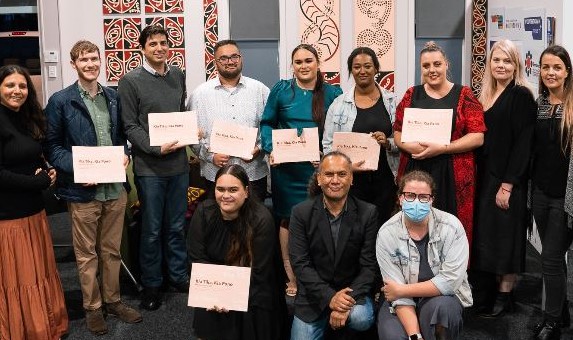
Above: VOYCE launches an ethical framework to guide engagement with care experienced tamariki and rangatahi.
Challenges
If a child or young person is willing to share their experience with an organisation or institution it can be incredibly demoralising if their testimony is disregarded or viewed as a tick box exercise. Contributions must be viewed as a taonga (a gift) which can lead to meaningful change.
When introducing (sometimes vulnerable) young people into new spaces and situations VOYCE has a responsibility to ensure that these are safe spaces where young people will be listened to with respect and understanding. This can be challenging, particularly when collaborating with organisations whose work is tailored towards adults. In response to this challenge VOYCE created Kia Tika, Kia Pono – Honouring Truths, an ethical framework designed to be used by organisations working with care-experienced young people. The framework covers how to engage in a way that is meaningful, culturally safe and recognises these children and young people as expert leaders (rangatira) with lived experience and knowledge to share.
VOYCE has many enthusiastic and committed young people who are keen to be involved, but participating in group sessions either in person or virtually can be daunting for some. There may also be physical or administrative barriers to participation, for example disabled people are over-represented in the care sector, and for those with special educational needs, having to make written submissions may not always be easy or possible.
When speaking to legislators and select committees, participants are only given five minutes for their testimony and are expected to speak live. Some young people do not have the confidence to speak in this way, or may find it traumatic to relive their experiences in this setting. VOYCE has been advocating to be able to provide video testimony.
A history of colonisation, entrenched disadvantage and systemic bias has led to M¯aori tamariki (children) and rangatahi being significantly over-represented in state care, yet M¯aori voices remain under-represented in advocacy and decision making within the care sector.
Next Steps
VOYCE is continuing to focus on building Regional Youth Councils across New Zealand as part of its Te Waka Rangatira (youth participation strategy). A network of staff members from across the regions have come together to form a community of learning to support youth participation activities, including the establishment of Regional Youth Councils. The aim is for this to be a space in which to share, learn, grow and inspire so that VOYCE can provide the best support to children and young people who want to connect and participate in collective advocacy.
Top Tips
- Those with lived experience are the experts in knowing what works for them. Projects, policy and practice should all be designed in collaboration with the cohort on which they will have an impact.
- Be upfront about the aims of the projects you engage people with. How will their k¯orero (narrative) be used? How will it impact change?
- Invest in building relationships. VOYCE builds relationships at the one-to-one level. Trust has been established before young people participate in the youth councils. Be culturally sensitive. Effective mahi (work) comes as a result.
One size will not necessarily fit all – when establishing Regional Youth Councils the design of the council should reflect the requirements of the region.
Contact Details
To find out more about VOYCE Whakarongo Mai’s work please contact: www.voyce.org.nz [email protected]
Further Reading
For more information on this topic VOYCE has published, Kia Tika, Kia Pono – Honouring Truths, an ethical framework to guide engagement with care experienced tamariki and rangatahi which can be downloaded via www.voyce.org.nz/kiatikakiapono/.
Two further case studies focusing on engaging young people in advocacy in Aotearoa New Zealand can be found here.
