


Yaim Chamreun, Executive Director of First Step Cambodia, spoke to the Changemakers Movement about how trauma-informed care works in practice. The session was hosted by William Gali, Senior Programme Advisor from Family for Every Child. The question that shaped his presentation was straightforward: what does it actually mean to deliver services this way?
What is trauma-informed care?
In his context-setting introduction, Gali spoke about the difference between trauma-informed and trauma-focussed care. Trauma-informed care is not a service type. It is not something you can measure and report. It is a way of working with people who have experienced trauma. This distinction matters because it changes what you need to invest in.
Trauma-informed care prioritises physical and emotional safety, trust and transparency, choice and collaboration, and avoidance of re-traumatisation. Teachers, social workers, health workers, community leaders and NGO staff can all work this way. You do not need a clinical qualification.
Trauma-focused care is different. It requires specialised therapeutic training to directly treat trauma symptoms or PTSD. The distinction is practical: every trauma-focused intervention should be trauma-informed, but not every trauma-informed service needs to be trauma-focused.
Six principles shape trauma-informed work: safety, trustworthiness and transparency, peer support, collaboration and mutuality, empowerment voice and choice, and cultural, historical and gender responsiveness. These are not abstract. They change how you design every interaction with children and families.
The ecological model in practice
Chamreun shared First Step Cambodia's organisational model that works at four levels: individual recovery and resilience; relationships with family, caregivers and peers; community protection through awareness and referral networks; and institutional frameworks that involve government and service providers. This ensures that supporting one child connects that child to the broader systems that sustain them.
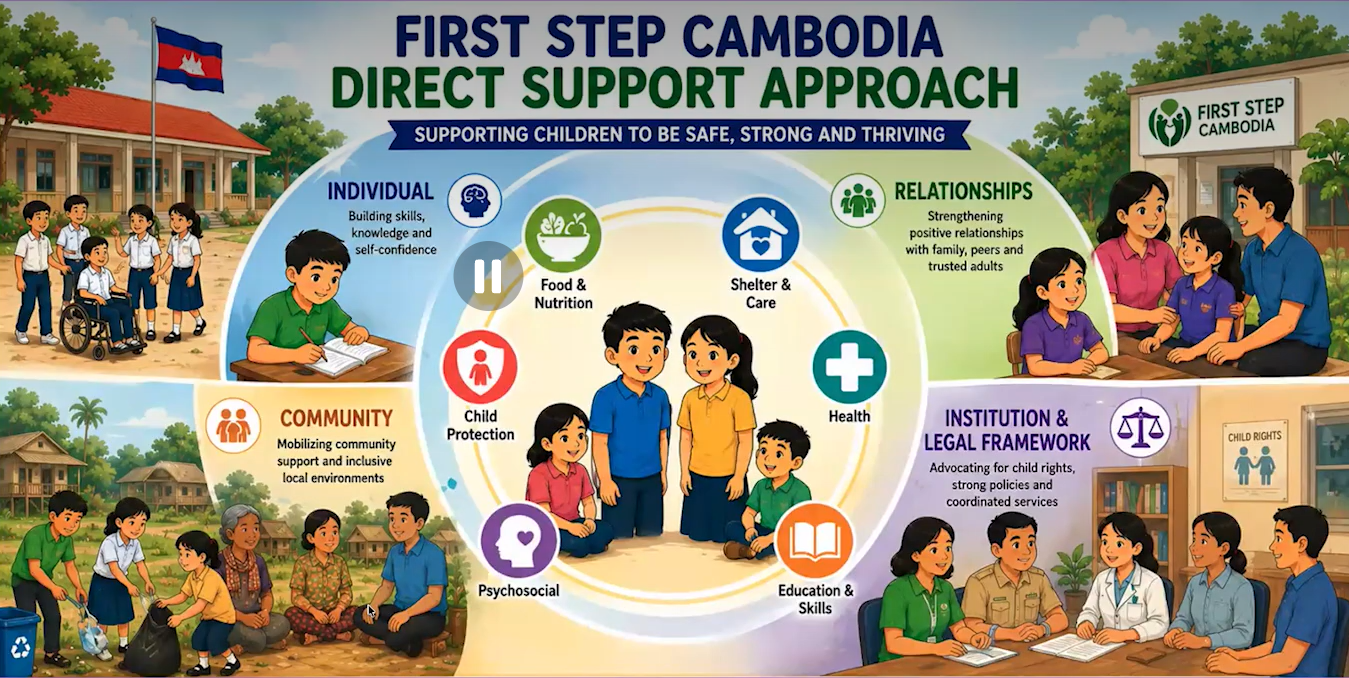
At the individual level, First Step staff focus on relationship building and trust. Children do not always engage in conversation. The team uses play-based tools: body maps where children paint different colours on their bodies while discussing trauma, puppets for children who prefer indirect communication, cloud and flower cards to identify problems and explore solutions. These are assessment and therapeutic methods grounded in how children actually communicate.
What support do families receive? First Step starts with an assessment. The organisation identifies what the family needs, then maps what exists in the commune and community. Does the government have a budget to support this family? Which NGOs work in this area? What gaps remain? Only then does First Step decide what support it will provide directly. This might be income generation support, vocational training, mental health capacity building for parents, or referral to government or NGO services.
For families where caregivers have their own mental health needs, First Step provides capacity building around problem identification, coping skills and solution-seeking. When needs exceed the organisation's scope, referral to clinical psychologists or psychiatrists happens because that is the right fit for the family.
This approach works because assessment is the foundation. You cannot build systems that serve children well without understanding what already exists and what gaps you can fill.
Staff care and wellbeing is essential
First Step treats staff supervision and wellbeing as the foundation of quality work. The organisation provides regular supervision where staff discuss support needs, identify capacity building gaps and discuss caseload adjustments. Beyond supervision, First Step runs team building activities and every six months the team spends two days reviewing what they have achieved and how their work has changed children's lives.
Staff working in child protection are exposed daily to stories of trauma and abuse. Without structures to process this, they experience vicarious trauma. They become cynical. They burn out. When staff burn out, the quality of support children receive declines. This is not a wellbeing issue. It is a practice quality issue.
Chamreun argued strongly that this investment pays for itself. Healthier staff are more effective staff. Organisations with these systems have lower turnover, more stable teams, and greater institutional knowledge. First Step also allows staff to access external supervision if they prefer not to discuss issues with their direct supervisor within the organisation.
This approach has influenced other NGOs in Cambodia to embed similar mechanisms. Once you see how it works, it becomes harder to argue that it is optional.
Working within the systems
Chamreun spent years as a frontline practitioner without formal training. When he later studied social work, he found a gap: practitioners had experience but lacked theoretical frameworks to explain what they were doing. Academic training provided theory disconnected from ground reality. Linking these two was the insight that drove him to systems work.
He became a technical member of Cambodia's national working group developing training curricula for the social service workforce. First Step has trained over 1,000 social workers. These training modules are now recognised by Cambodia's Ministry of Social Affairs. The organisation also works with community key people on child protection awareness and response.
This is not waiting for policy to change. It works within existing government structures, including the Commune Committee for Women and Children, and uses partnership with local NGOs to expand reach. It requires investing in relationships with officials, participating in technical working groups, translating practice learning into policy recommendations. This work happens during lunch and coffee breaks alongside official responsibilities. When political change brings new officials, relationships must be rebuilt. This is not wasted time. This is how systems change.
Funding constraints are real
Donors attach restricted grants and time tracking requirements that leave no space for staff capacity building. Building relationships with government counterparts requires investment that restricted funding does not cover. When political change brings new officials, relationship building must restart.
Community resistance comes up. When First Step works with children who display harmful sexual behaviour, community members question why the organisation supports "perpetrators" rather than survivors. Chamreun explains repeatedly that children have the right to development, that harmful sexual behaviour often stems from their own trauma or lack of understanding, and that prevention of future abuse requires intervention now.
Where stable families or trusted adults do not exist, First Step partners with organisations like Children in Family and Melophree that provide emergency foster care and longer-term family placement. In one case, a girl displaying harmful sexual behaviour had been moved between residential care facilities. Neither she nor her caregivers understood her behaviour. When placed in a foster family with First Step support, the foster father initially responded with violence, which worsened the behaviour. Through intensive work with both the girl and the foster father, understanding improved, violence stopped, and the girl's behaviour changed.
This required long-term commitment and genuine partnership. It meant First Step investing time in coordination and relationship building with organisations whose expertise was different.
What this means in practice
Trauma-informed care is not a training course you complete and then move on. It is an operational framework. It requires supervision structures, not just policies. It requires building space for staff to reflect and recover. It requires assessment before service design, not service design followed by referral.
It also means working at multiple levels simultaneously without trying to do everything yourself. First Step works with partners because some expertise lives elsewhere. They work with the government because scaling training requires that collaboration. They work with key community people on prevention awareness because the community is where change takes root.
The ecological model works because it distributes responsibility rather than concentrating it. A child does not recover through one relationship alone. Recovery happens through the relationship with a trusted social worker, support of a strengthened family, awareness-raising in the community, and the policy framework that makes service coordination possible.
Trauma-informed is a lens through which all services are delivered. It is a set of principles that shapes practice. It is not a programme. It requires staff who are supervised, supported and given space to reflect. It requires partnerships because no single organisation has all the answers. And it requires honest conversation about what you can do and what you cannot, what donors will fund and where you have to advocate for different investment.
Join the Community of Practice
These insights emerge from practitioners learning from each other in real time. First Step Cambodia's approach is not finished. It continues to evolve as the organisation encounters new challenges and learns from what works.
This is the point of the Family for Every Child Community of Practice on Mental Health and Emotional Wellbeing. The practice is built on shared experience. If you are working in child protection, mental health, family strengthening or community resilience, your learning matters. Your challenges matter. What you have tested and learned from matters to others facing similar obstacles.
The Community of Practice brings together practitioners across member organisations and beyond to share what is working, what is not, and how you are thinking through the obstacles.
Join the Community of Practice on Mental Health and Emotional Wellbeing. Your experience and the questions you are asking are part of how the field advances.