


Introduction
Uyisenga Ni Imanzi (UNM), a community-based NGO working across Rwanda, was established in 2002 in response to the high number of children and young adults who became orphans and heads of their households as a result of both the 1994
Rwandan genocide and HIV/AIDS. UNM works with children and communities, delivering social support and education programmes.
As the 30th commemoration of the genocide approached, national and international discussions focused on intergenerational trauma and the need to develop a dialogue between the generation who lived through 1994 and those who were born afterwards.
Recognising that many traditional models focusing on intergenerational trauma were western-based and not applicable to the specific social, political and cultural context of Rwanda, UNM wanted to develop a programme which was culturally
appropriate and co-created by the community, and that would help foster meaningful conversations across generations, address sensitive issues, and promote wellbeing for children, families and communities. UNM was also determined that the programme would not focus exclusively on the experience of trauma, but rather would support participants to develop resilience within themselves, their families and their communities.
Please read on for more information about the project, alternatively this study is available to download as a PDF.
The Model
The Nkwihoreze project (a Kinyarwanda term that translates to ‘I comfort you while you cry’) is a psychosocial intervention developed and piloted in Rwanda by UNM in collaboration with community organisations. Rooted in narrative therapy and enriched by using culturally contextualised art-based methods, the model was designed to support emotional healing, family cohesion, and intergenerational resilience, particularly in post-conflict communities.
The programme centres on family dialogue – a structured yet flexible process that brings family members together to share emotions, memories, and hopes. This is achieved through facilitated sessions using storytelling, drawing, music, metaphor, and other creative forms of expression. These methods are
intentionally non-clinical and accessible, ensuring that participants feel safe, empowered, and respected.
A key feature of the model is its use of young people as lay facilitators. To date, the project has employed 14 young facilitators (aged 16–25) and nine psychosocial workers (aged 22–28), many of whom are members of genocide survivors’ associations. These facilitators receive training ahead of delivering the sessions but
are not formally qualified as mental health practitioners. Their involvement fosters local ownership and ensures the relevance and sustainability of the work.
Sessions are held separately for children and their parents or caregivers, followed by joint family sessions. Activities often involve ‘assignments’ that families complete at home, reinforcing learning and communication among family members between the sessions. Cultural tools such as songs, proverbs, and visual metaphors are embedded throughout, making the process both familiar and
deeply resonant for participants.
Workshops and the tools used
The body mapping tool
The purpose of the body mapping tool is to encourage young people to think about the impact of intergenerational trauma and if this can be transformed into intergenerational resilience. Sessions are two hours long and guided by a facilitator.
In the first part of the session, children draw an outline of a person and are asked to imagine someone who is experiencing trauma. The project facilitator then asks ‘What might this person be feeling?’. Children are encouraged to write or draw on the body map to express the character’s emotions. In the second part of the session the activity is repeated but this time the children imagine they are drawing someone who is resilient. At the end of the session participants share their body maps and discuss the differences between the characters created in the first and second sessions.
By creating this safe and supportive space children are able to explore feelings, ideas and memories and begin to process them. This generates discussion around how and why people feel certain ways, and how the body responds to the emotions we feel. Feedback collected from participants at the end of each session
is considered and used to shape further sessions, meaning the practice is being continually developed and refined.
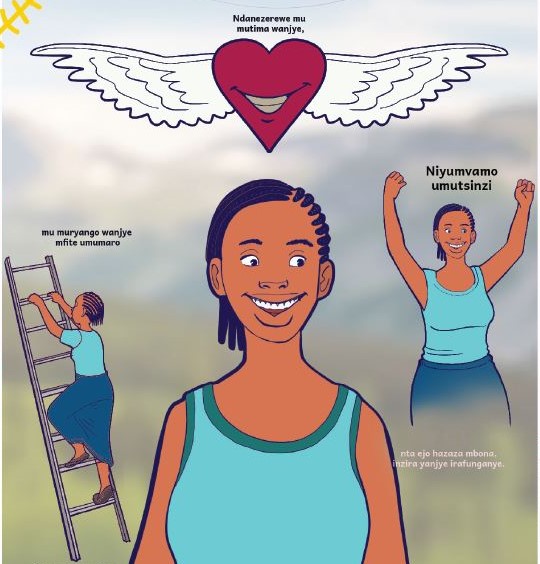
Above: An illustration from the Nkwihoreze workbook. A woman is surrounded by versions of herself representing balance in emotions, body, actions and relationships, achieved through self-awareness using the Body Mapping Tool.
The family table tool
This tool is designed to help families reflect on the challenges they face together, as well as the strengths and skills that they have to face them. A facilitator works with a family group, which may be parents/ carers and children. Sessions are one and a half hours long and take place in an informal setting, around a table, or seated on the ground.
Families draw a large cooking pot, which represents a family. The facilitator guides the family to discuss what makes them strong and resilient. These are attributes that create the fire to cook the stew and they are placed (drawn or written) under the pot. Next, they place ingredients inside the pot which can combine to make a delicious stew. These can be the strengths, skills and actions of each family member. Participants may also identify bad ingredients which can spoil the stew; these are placed in a pile away from the pot. For example, shouting or not listening could be placed in this pile.
It is important that ingredients, both good and bad, are not linked to one family member in particular and names are not attached to actions or behaviours. The objective of the session is to consider the strengths of the family and identify any issues as a group: it is not about placing blame with any one individual. At the end of the session the family comes together, to reflect on which ingredients they would like to have more of, and which are not necessary in their family stew.
Resources required
- Human resources: Trained facilitators (lay youth and some psychologists) to conduct capacity-building workshops.
- Materials: Drawing supplies such as flipcharts, pens, sticky notes and paper; audio recording equipment for groups who want to create music and songs; visual tools illustrating family exercises.
- Logistics: Transportation support for facilitators and participants (especially in rural areas); venues for sessions and exhibitions; refreshments.
- Artistic support: Artists, writers and a photographer to translate workshop content into songs, visual tools, and manuals.
Community engagement tools: Sound systems, tents, and spaces for public exhibitions.
Outcomes
Families who have taken part in the Nkwihoreze project reported significant improvements in emotional expression and openness, leading to enhanced trust and connection between parents and children. For many, the project offered a rare opportunity to share deeply held thoughts and experiences in a safe environment. Children particularly appreciated the safe space to ask questions. And parents commented that they drew inspiration and healing from their children.
Community participation and ownership was essential to this approach. The training of local ‘Inshuti z’Umuryango’ (Friends of the Family) created a network of facilitators rooted in the communities they serve. The use of culturally appropriate tools, metaphorical language, proverbs and visual storytelling allowed participants to engage with complex emotions in ways that felt natural and resonant.
Just as the delivery of the project relied on local culture and metaphors, so too did the monitoring tools. The team recognised that asking direct questions does not always lead to the most insightful feedback and sought alternative ways to understand participants’ experiences. For example, through use of the circle of
trust tool participants are asked to choose the level of trust they felt in a family member (no trust, barriers to trust, overall trust) at the beginning and end of the sessions to track qualitative change in areas like emotional wellbeing, trust, and family dynamics. The artwork created during these sessions has been used to
create an exhibition which has travelled to multiple locations within Rwanda and been displayed at the Being Human festival in London.
Challenges
Implementing such a deeply participatory and culturally sensitive model came with a number of challenges. Translating Western therapeutic concepts such as ‘intergenerational trauma’ and ‘resilience’ into local languages and frameworks required thoughtful adaptation. In some cases, older and younger participants
struggled to connect across generational divides, especially when
interpreting traditional sayings or songs. However, these tensions
often opened up space for meaningful dialogue.
Facilitators, many of whom came from the same communities and histories as participants, sometimes faced emotional strain themselves. Supporting others through difficult topics often triggered their own unprocessed experiences, underscoring the need for ongoing support structures. Logistically, the programme demanded significant levels of coordination, with the majority of the sessions being delivered in rural areas. The full-day workshops, held on weekends to accommodate children’s school schedules, also posed time
challenges for families.
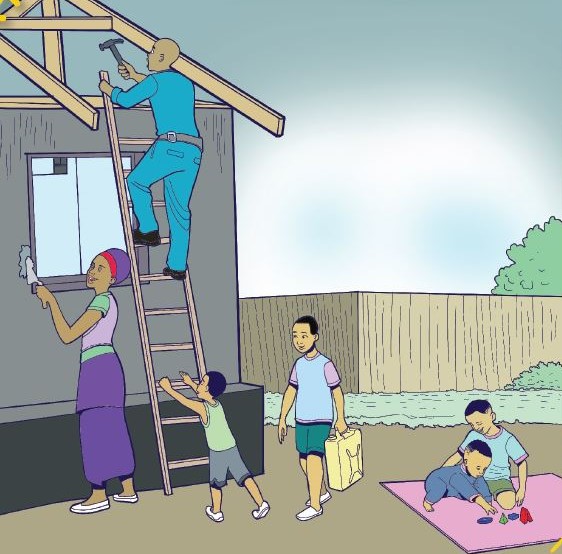
Above: An illustration from the Nkwihoreze workbook, highlighting that every family member has a valuable role and contributes in their own way.
The emotional intensity of the sessions sometimes brought unexpected disclosures. In one case, a child asked his mother to identify his father – a question that had never been addressed before. Situations like these required careful, compassionate facilitation and, when needed, referrals for individual follow-up
support.
The team focused on adapting the programme in response to these challenges, with facilitators and community members continuing to shape and refine the programme as it evolved.
Next steps
Following the pilot’s conclusion in Rwanda in March 2025, the Nkwihoreze model is being adapted and piloted in diverse contexts, including Rwanda’s diaspora communities (starting in Canada), and with Family for Every Child members in Nepal, Kyrgyzstan, Indonesia, and Colombia. The model’s flexibility and cultural adaptability make it a promising tool for use in various settings, particularly in communities experiencing post-conflict trauma or family fragmentation.
UNM is also exploring thematic extensions of the model. One emerging area is the reintegration of children returning to their families after time living on the streets or in a rehabilitation centre. Here, the model offers a process to rebuild trust and togetherness in families through creative expression and structured dialogue.
Another focus is supporting kinship caregivers, where psychosocial needs often go unaddressed.
Additionally, efforts are under way to embed the approach within formal education and training systems. UNM is collaborating with the University of Rwanda and University College London to develop a continuing professional development (CPD) course. This training will equip practitioners – including social workers and educators – with the tools and values of the model, further embedding its principles into practice. Ultimately, the goal is to see this approach
evolve into a replicable, evidence-informed framework that can serve families across diverse global contexts.
Top tips
- Empower the community: People are the experts on their own challenges and solutions. Use tools to support rather than replace their insights.
- Experience the tools yourself: Facilitators should personally engage with tools before leading others through them.
- Use culturally-grounded tools: Proverbs, songs, drawings, and colours often communicate more effectively than direct questioning.
- Be flexible: The model should evolve with the community – stay open to co-creation and spontaneous adaptation.
- Provide support for facilitators: This type of work can be emotional and lay facilitators may carry their own emotional burdens – build in support systems for them.
- Energise participants: Facilitators use ‘Ikiraro’, meaning ‘together we can build a bridge’, as an ice breaker and energising activity to start the session. Using music and movement helps to build connections and reduce anxiety for participants.
Keep it friendly: This isn’t clinical therapy – it’s about creating safe, welcoming, human spaces for real conversations.
Contact details:
To find out more about Uyisenga Ni Imanzi’s work and the Nkwihoreze project please visit: youtube.com/@Nkwihoreze or nkwihoreze.org
This project is funded by the Arts and Humanities Research Council (AHRC) grant number AH/Y004760/1
