

Introduction
Mission Ukraine was launched in early 2022 by For Our Children, a Bulgarian civil society organisation with offices in Sofia and Plovdiv, in response to the war in Ukraine. While initially focusing on providing humanitarian aid through the delivery of essential supplies to refugees, mainly mothers and children, the programme quickly evolved into a comprehensive, multi-level support initiative
for Ukrainian refugee women and children living in Bulgaria. The programme provides practical support through food packages, dignity kits, and other material aid and psychosocial support via peer support groups, structured group activities and therapeutic work with young children.
Please read on for more information about the project, alternatively this study is available to download as a PDF in English and Bulgarian.
The model
Prior to 2022, For Our Children had no experience in developing programmes for refugees, and was faced with building a programme from scratch. The first stage of the process involved the recruitment of a new team, including social workers, cultural mediators, speech therapists and facilitators, who are responsible for arranging and facilitating support sessions for women and children. Of the 14 new members of staff who joined the team, 12 were Ukrainians fleeing the conflict.
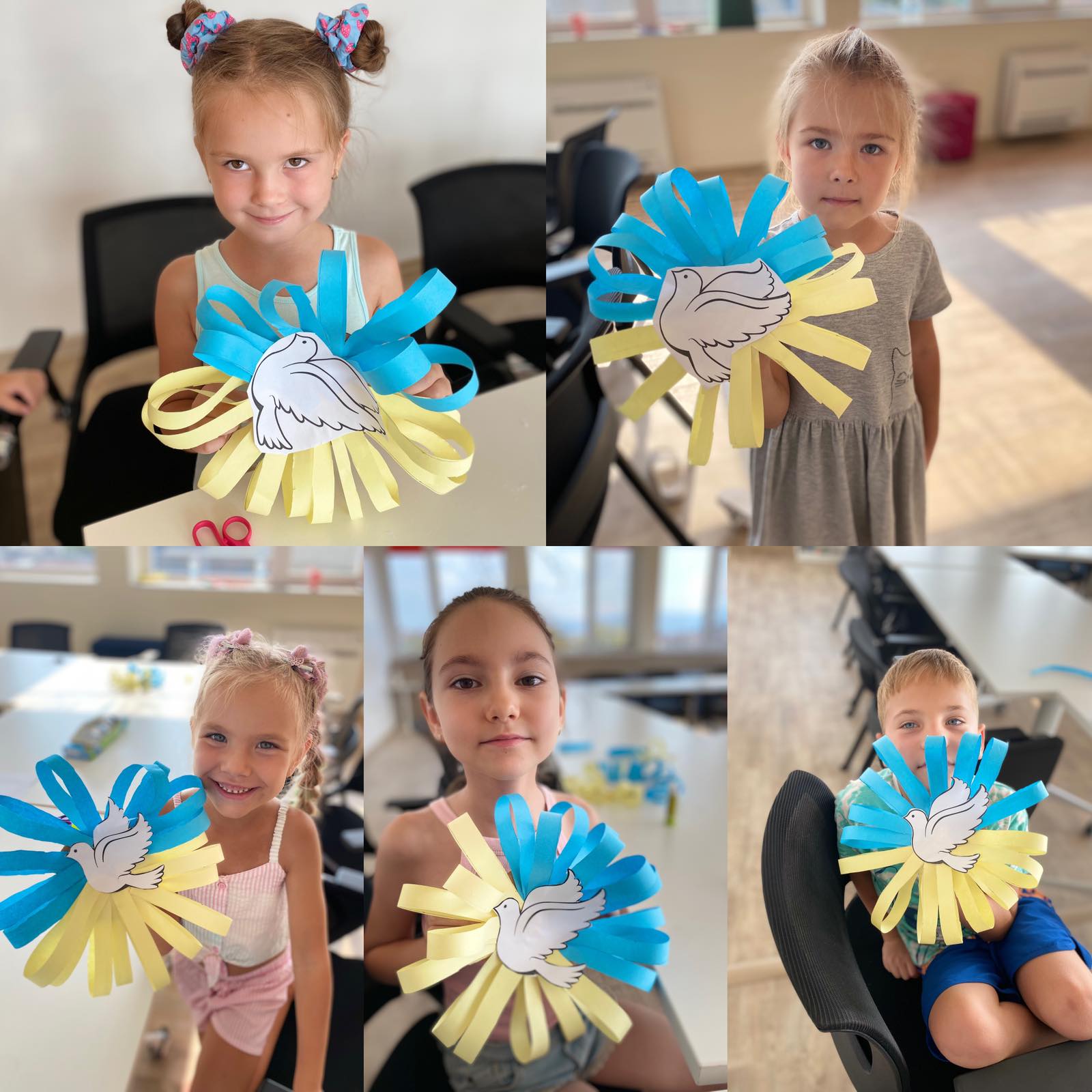
Above: Children display their artwork symbolising peace in Ukraine.
Mission Ukraine’s ambition is to provide psychosocial support to Ukrainian refugee families by creating child-friendly social spaces which provide a sense of normality for children and offer support to their mothers—the majority of whom are raising children alone while their husbands remain in Ukraine. Peer support groups have been essential to protect mothers’ mental health, while the childcare available has allowed women to attend job interviews and medical appointments, or simply take some time for themselves.
Cultural mediators have also been able to help navigate the school application system to ensure children continue with their education. These activities take place in two complexes for early childhood development run by the organisation in the two biggest cities in Bulgaria – Sofia and Plovdiv.
As the war has continued, and based on the feedback received from mothers, Mission Ukraine has focused on child-centred activities, helping children to establish routines and make friends. Sessions are tailored to particular age groups and children may play games or create artwork. The programme also facilitates
mixed sessions where Ukrainian and Bulgarian children can play together. This is designed to support integration between the two communities, recognising that families staying longer in Bulgaria are increasingly likely to consider long-term settlement. These sessions have helped to prepare preschool aged children for the
Bulgarian educational system.
Mission Ukraine offers specialised support for children including access to speech therapy, rehabilitation, and social work services. For many children with additional needs, the challenge of running from a war has been compounded by losing access to the therapists who were providing them with additional support. For
Our Children has prioritised recruiting professionals from within the refugee community, ensuring that Ukrainian specialists – including teachers, physiotherapists, and speech therapists – can continue their work while supporting children with diverse needs. Bulgaria and Ukraine have deep common roots and a lot of Ukrainians have relatives in Bulgaria, have studied in the country and speak the language. This helped the organisation to recruit a team of cultural
mediators, who play a key role in bridging language and cultural gaps and supporting families to navigate their new environment.
In the summer of 2024, For Our Children added a new activity to its portfolio. The Children’s Academy for Sustainable Development was created as a new way of supporting parents from different vulnerable families, including Ukrainian refugees. Children in two age groups, 4–7 years and 8–12 years, participated in half- or whole-day group activities in the Complex for Early Childhood Development in Sofia. This gave their parents (most of them single mother Ukrainian refugees) the opportunity to use their time for medical appointments, administrative engagements, or job searching, or to relax and prevent parental burnout.
The Psychological First Aid programme
In addition to providing direct support for refugees, For Our Children has delivered the Psychological First Aid programme, developed by the International Step by
Step Association. This programme is designed to train professionals how best to support children who have experienced stress and trauma. To date, 14 training
courses have been delivered by For Our Children with 200 professionals taking part, including social workers, psychologists and kindergarten teachers.
The objective has been to build the capacity of professionals across Bulgaria to support children within the refugee community, rather than having this specialism centred only in the cities of Sofia and Plovdiv where For Our Children
currently works.
Outcomes
The Mission Ukraine programme has reached over 2,000 beneficiaries, including 1,500 children. Exit surveys and direct observations indicate that the initiative has positively influenced participants’ mental health and integration.
Families have benefitted from long-term, continuous support, with some remaining engaged from the initial stages of documentation assistance through to job placement and community integration activities. The programme’s adaptable approach has allowed for tailored interventions based on families’ evolving needs.
However, as For Our Children emphasises, integration is a complex process without a definitive end point. This makes measuring outcomes challenging as families may exit the programme and then return at times when they need additional support. Indeed, this in itself should be seen as a positive outcome as refugees are able to identify sources of support and approach the appropriate
agencies for help.
Resources required
- Staff training and wellbeing: Professional development and supervision to support frontline workers, prevent burnout, and ensure high-quality service delivery.
- Expertise and commitment: Skilled professionals in social services management, alongside a dedicated team committed to refugee support. Recruiting staff from the Ukrainian community in Bulgaria has helped to bridge cultural gaps and support integration.
- Adaptability: A flexible approach to evolving refugee needs rather than fixed, pre-determined solutions. Seeking input from participants and implementing changes based on feedback received has allowed the programme to develop as refugees build their lives in Bulgaria.
- Financial support: Funding from international partners such as the International Rescue Committee, the World Childhood Foundation and Family for Every Child.
"Many thanks to Natalia for being so understanding of our situation and helping us. She also provided psychological and moral support on a visit to a traumatologist when my leg was broken, acting as translator and asking the right questions. A deep bow to all the foundation’s employees for their support. Thank God that we have you!"
Svetlana Serdyuk -
Mission Ukraine participant
Challenges
Despite its successes, Mission Ukraine has faced several challenges and has needed to adapt accordingly. For example, the programme had to adjust initial plans for psychologist-led sessions after realising that refugees preferred open-ended peer support spaces. Maintaining staff wellbeing has also been a challenge,
as many social workers and facilitators are refugees themselves, facing both professional and personal difficulties.
Political instability in Bulgaria has slowed state-led refugee support efforts, increasing reliance on civil society initiatives. Access to public services has also presented difficulties, with Ukrainian children facing bureaucratic hurdles such as vaccination requirements when enrolling in schools. Additionally, outdated
statistics on Ukrainian refugees in Bulgaria have made it difficult to assess the full scale of the situation and adapt strategies accordingly. Meanwhile, many parents, who are struggling themselves after fleeing their homeland, have focused on
immediate concerns like securing housing and employment, and have not sought specific support for their children’s wellbeing and education. It is likely that as Mission Ukraine continues, its work will focus on the additional needs of children who have been outside of the education system for some time.
As the war in Ukraine persists, the number of refugees living in the country continues to grow. Bulgaria has been the target of sustained disinformation campaigns, primarily from Russia, which have fuelled resistance to refugee integration. In addition, a second wave of refugees is now arriving, often from third countries where they have faced hostility. They have travelled to Bulgaria in the
hope that cultural and linguistic similarities could make integration a simpler process.
By supporting integration efforts and fostering connections between Ukrainian and Bulgarian communities, Mission Ukraine helps to counter these narratives and promote social cohesion.
Next steps
Mission Ukraine has now become a formal part of For Our Children’s community support centres in Sofia and Plovdiv, ensuring the programme’s continuity for at least five years. The programme continues to shift its focus from providing humanitarian aid and psychosocial support to integrational activities for refugee
families. For Our Children plans to use the skills and knowledge gained from Mission Ukraine to support other displaced populations in Bulgaria. Strengthening international collaboration remains a priority, with partners including the International Rescue Committee, the World Childhood Foundation and Family for Every Child. The Mission Ukraine team is also planning to create a practitioner’s guide which will document best practices and gather insights to support other organisations and government bodies providing psychosocial support in emergency contexts.
Top tips
Alongside this the Psychological First Aid programme will continue to be delivered across Bulgaria. The Ministry of Education has certificated the programme, meaning that students receive a nationally recognised qualification upon completion of their training.
- Invest in staff support: Regular training, supervision, and mental health support help prevent burnout among frontline workers.
- Stay flexible: Programmes must be adaptable and respond to the changing needs of beneficiaries.
- Employ cultural mediators: They can bridge language and cultural gaps and support families to navigate their new environment.
- Encourage social integration: Fostering connections between refugees and local communities enhances long-term wellbeing and inclusion.
Ensure sustainability: Integrating programmes into existing institutional frameworks and securing long-term funding sources are key to continuity.
Contact details:
To find out more about Mission Ukraine and the work of For our Children please contact:
www.detebg.org/en/mission-ukraine
[email protected]
